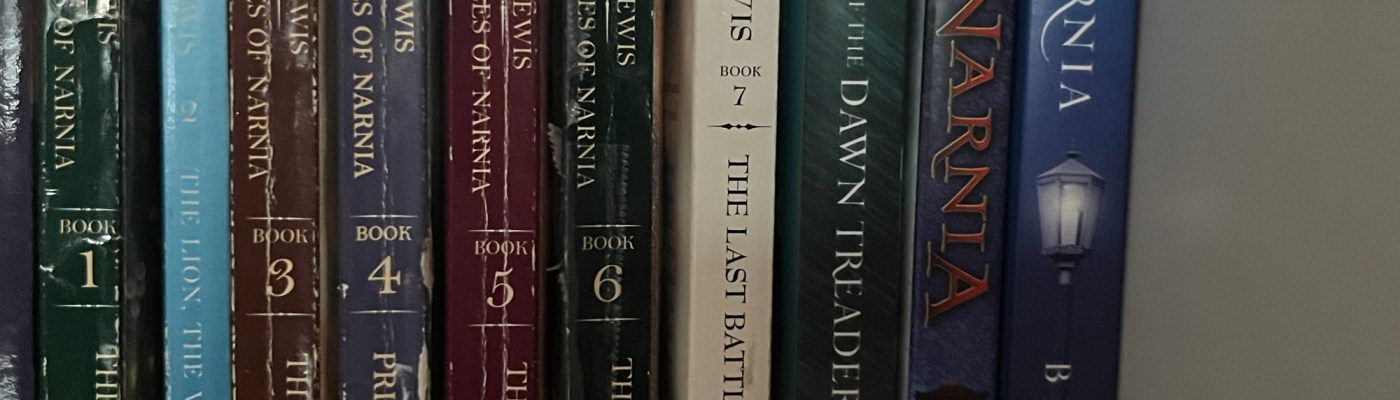
Since it is so likely that children will meet cruel enemies, let them at least have heard of brave knights and heroic courage.
– C.S. Lewis
You know by now that I love reading C.S. Lewis’ works. After all, The Last Battle inspired the name Back to Stable Hill. Narnia is one of my favorite childhood series. When Walden Media/Disney came out with the three movies, I was infatuated.
But why do we love stories so much? As I was doing some research on this, it turns out that the morals or lessons you learn along the way are just side quests. The reason we tend to love fairy tales is because we can relate. We can aspire to be a character in the story, and we can usually find ourselves in a character as well.
Take The Lion, the Witch, and the Wardrobe for example. In Peter, you see a guy who always charges in, willing to fight for his family and those he just met, against what is wrong. In Susan, you see a girl who is very practical and doubtful, yet will stand with her family and help keep them safe. Edmund is the one who thinks he knows what is right, and he’s tired of everyone pressuring him and telling him what to do, so he sets out on his own. All the way to Lucy, who believes in what’s right whole-heartedly, whether people stand with her or not, and she makes friends with almost anyone.
You can probably relate with one (or more) of the Pevensies. Only when you’re older, do you start to put pieces together about the underlying tones to the characters.
I always thought I was Susan – she was always my favorite character (and the reason I took up archery). I wasn’t Lucy, I’m not nearly as trusting as she is. I’m more like Susan, suspicious, afraid to leave what she knows. At the first sign of danger, she’s the one saying “We should go back home where it’s safe and avoid all of this trouble – we don’t know what’s going to happen.” Her three siblings say that someone needs their help – they can’t just leave. And she follows them, because she wants to be there to keep her family safe. Peter doesn’t always think before he does, Lucy is too trusting, and Edmund…is Edmund. (If you’re a fan of Susan, though, don’t read The Last Battle – I cried).
But now that I’m older, I still see myself as Susan, but I also see parts of me in the other siblings. In Prince Caspian, Peter was so headstrong. He had been High King before, and he didn’t need to wait on Aslan, he knew how to defeat the bad guy without Aslan’s help (spoiler: it did not go well). In The Voyage of the Dawn Treader, Lucy started doubting herself. She kept comparing herself to her sister, who didn’t have any trouble getting dates and everyone always said she was so pretty. In Prince Caspian, you have Edmund, who had experienced what it was like going against Aslan’s wishes. He’d done it once and it nearly resulted in him dying and losing his whole family. He wasn’t about to do it again. But he had his own battle to fight in The Voyage of the Dawn Treader – all of his mistakes that he made in The Lion The Witch and The Wardrobe came back to haunt him, and he got lost in those.
In these stories, you can always resonate with one or more of the Pevensies. You also can see the Pevensie that you would want to be. I would want to be Lucy – fully trusting what Aslan says and not pausing for a moment to doubt him (although she is not without her flaws).
Realistically, the Christian should find themselves in Edmund. Everyone knows in The Lion The Witch and The Wardrobe that Aslan died to save Edmund from his mistakes. In Prince Caspian, Edmund is looking at his self-righteous brother and knows from his past that it only leads to destruction. And in The Voyage of the Dawn Treader, evil knows how to get him to doubt by bringing up his past.
There are so many ways you can relate to and learn from the four Pevensie siblings (and even the other characters in the books) throughout Narnia. And the reason we are captivated is the storyline, yes – but also how we can see ourselves in the story, and relate it to the real world. You can do this with any story that you loved as a child – whether it be The Lord of the Rings or Alexander and the Terrible, Horrible, No Good, Very Bad Day (because we all have bad days, even in Australia – you just have to know how to handle them).
But these stories can also shape our character, showing us good and bad, give us hope, and although they may be marketed to children, adults can get more out of it. I had to grow up before I realized some more things about the Narnia series – things I didn’t think about or completely understand when I was younger.
This was the very reason why you were brought to Narnia, that by knowing me here for a little, you may know me better there.
– Aslan, The Voyage of the Dawn Treader
Read a book that you loved as a child, try to think about why you like it so much and how you can learn and apply things from it in your life today.
Someday you will be old enough to start reading fairy tales again.
– C.S. Lewis
If you are not 100% sure that you’ll go to Heaven when you die, now is the time to repent and put your trust in Jesus Christ. If you have any questions or doubts about your salvation, click here to learn how you can be saved. After all:
Jesus Christ did not say, ‘Go into all the world and tell the world that it is quite right.’
– C.S. Lewis
Discover more from Back To Stable Hill
Subscribe to get the latest posts sent to your email.
 Back To Stable Hill