Today is our final installment in this series. We’ve already discussed signers from Virginia, Pennsylvania, Maryland, North Carolina, and South Carolina, Connecticut, Delaware and Georgia, Massachusetts and New Hampshire. That leaves New Jersey, New York, and Rhode Island. Let’s look at the signers from those states.
New Jersey
Abraham lost two good friends who were assassinated by the British at two separate points in the Revolutionary War: Reverend James Caldwell and his wife. Two of Abraham’s sons were captured by the British, and the British offered their release if Abraham would switch sides. He never did, and one of his sons died from the treatment he received during his capture. Throughout the Revolutionary War, Abraham was always available to vote when Congress was needed, and he also raised money for the war efforts. He continued in politics until his death in 1794. Just days after he voted for independence, he wrote to a friend:
“Our Declaration of Independence I dare say you have seen. A few weeks will probably determine our fate. Perfect freedom, or Absolute Slavery. To some of us freedom or a halter. Our fates are in the hands of An Almighty God, to whom I can with pleasure confide my own; he can save us, or destroy us; his Councils are fixed and cannot be disappointed, and all his designs will be Accomplished.“
Just a month later, Abraham wrote to the same friend after he had signed the declaration, stating: “Perhaps our Congress will be Exalted on a high Gallows.” Just like his fellow signers, he knew the risk of declaring independence, and he paid it, with the death of his friends and his sons by the hand of the British.
John used his plantation wealth to supplement his public service duties, which he was meagerly paid for. He served on several committees and had been appointed Justice of the Peace. In 1774, he was elected to a committee to “elect and appoint Delegates to the First Continental Congress, and to protest the Tea Act”. John was elected to the Second Continental Congress, where he immediately voted for independence, and was the thirteenth signer of the Declaration. John’s wife died two months after he signed the declaration, and two months after that, John was on the run from the British. He was hiding in caves, mountains – wherever he could to escape the British. After Trenton and Princeton, John was finally able to return home. Two years after he voted for independence, General Washington accepted his offer to camp at his plantation, and he had over 12,000 men camping there. Four days later, these men won the Battle of Monmouth. In 1779, John died of kidney stones. He had lost so much money due to the war effort, his home was sold to recoup the loss.
Francis resigned his Crown appointed positions in law in 1776 and was elected to the Second Continental Congress, where he voted for independence and signed on August 2nd. He left Congress in November 1776 to work on the Navy Board in Philadelphia and his law practice. In 1777 he provided his own design for the U.S. flag, although it was not chosen. President George Washington appointed Francis as Judge of the United States District Court for the Eastern District of Pennsylvania. Before his death in 1791, Francis designed seals for The Board of Admiralty, The Treasury Board for use with the Continental Currency, and served on the committee to prepare the Great Seal of the United States of America.
Richard does not have a happy ending to his tale. Before Richard even arrived in America from his travels, he was attacked in Edinburgh by a robber, but he defended himself. In Ireland, he had booked to cross the Irish channel, but his luggage was delayed. The ship he would have been on sank in a storm and all perished. In 1774, Richard was on the New Jersey Supreme Court, and when war was threatening to break out, he wrote to Lord Dartmouth (Secretary for the Colonies) a plan for the self government of America, with allegiance to the Crown but independent of parliament. He warned that if this was not done, the result “would be an obstinate, awful, and tremendous war.” Richard and John Witherspoon were caught up in a storm in July 1, 1776 and asked John Adams to repeat his speech for independence, which he eventually conceded to do.
After Richard signed the Declaration, he travelled around to see what provisions were needed for the war effort, and he did all he could to supply them. When New Jersey was invaded by the British, Richard moved his family to a friends home thirty miles from Princeton. There, he was captured by loyalists in the middle of the night and jailed in Perth Amboy and then New York. 12,000 individuals died in those prisons compared to the 4,435 battle deaths. Treatment was horrible, he was starved, freezing, and in chains. General George Washington protested the inhumane treatment in January 1777, and General Howe eventually gave him parole, which forced Richard to resign from Congress, as he could no longer participate in the war effort. Yet, Richard refused to switch sides to the British through all of it.
Upon his release, he found Cornwallis had occupied his home, burned his library, and had destroyed or taken anything of value. Dr. Rush, a fellow signer, wrote that it took Richard nearly two years to recover from when he was near death at his release. While it was a slow recovery, Richard developed cancer and died in 1781. He did not live to see America be a free country.
John was the only clergyman to sign the Declaration of Independence. John received an appointment to the Continental Congress after he urged for the removal and imprisonment of New Jersey’s Royal Governor. On July 2, 1776 when a delegate opposed the Declaration declaring “we are not ripe for revolution”, John responded, “Not ripe sir, we are not only ripe for the measure but in danger of rotting for the want of it.” In 1777, one of his sons died in the Battle of Germantown in Pennsylvania. After the war, John designed the seals for the Navy department and the Treasury, and was a member of the ratifying convention, helping New Jersey be the third state to ratify the new Constitution. He died in 1794, having lost his eyesight before then but continued to help fight for independence
New York
William served in the militia and was a trustee of the town, an obvious selection for the Continental Congress. During his time in Congress, William was elected Colonel of the Western Regiment of Suffolk County. New York had not allowed their delegates to vote for anything like independence, so the delegates from New York did not contribute to the conversation in July 1776. Mid July, New York finally said the delegates could vote for independence, but the vote had already been cast without them. William, however signed the Declaration in August. The British pretty much immediately took Long Island, where William’s home was. His family narrowly escaped the British, and his property and home were destroyed. During this time, William had been promoted in the militia to Major General. His wife died in 1781 from illness, and the family was unable to return to their home until 1783, when they found it destroyed by the British. William died in 1821.
Francis had an interesting life before the Revolutionary War. He supplied uniforms to the British during the French and Indian War. In 1756, Fort Oswego was attacked by the French and their Indian allies. Francis was standing beside Colonel Mersey, the fort commander, as he was killed in battle. The French General Montcalm accepted the fort surrender under assurance of safety, but then he let the Indians take thirty prisoners to do whatever they wanted to. Francis was among those thirty, facing certain captivity or death. However, he was able to speak with them, having found their language similar to his native language in Wales. The chief was impressed and said he should be returned to his family. Instead, he was transported to France as a prisoner, and in 1763 he was released back to the Colonies in a prisoner exchange, where the British gave him 5,000 acres of land in New York as an apology for the seven years he had just lost.
When taxation without representation rolled around, he was known as one of the leading rebels in New York, becoming a founding member of the Sons of Liberty. He did sign the Olive Branch Petition, and like his fellow New York delegates, was unable to vote for independence. He did sign in August. Just after the Battle of Brooklyn that same month, British Captain Birtch was sent to destroy Francis’ home. And he did so, taking Francis’ wife captive, throwing her into a prison with little food. When General Washington found out, the British Paymaster-General’s wife and the British Attorney-General of Pennsylvania’s wife were captured. General Washington announced they would receive the same treatment as Mrs. Lewis. An exchange was made, but her health was frail. She died in 1779. The year before her death, her husband signed the Articles of Confederation, one of 16 signers who did so. He died in 1802 and is buried in an unmarked grave at Trinity Church.
His son, Henry Philip Livingston, was a soldier in General Washington’s Guard. Philip was in held several offices, and established the Chamber of Commerce in New York. He originally did not want immediate separation from Britain, but aligned with the patriots when Britain showed that they did not care about the colonies. He did sign the Olive Branch Petition, and like his other New York delegates, did not vote for or against independence. He did sign the Declaration in August 1776. He served as a senator and in the United States Congress. Philip died in 1778. Before his death, the British took his home when they took New York and burned it to the ground.
Lewis knew that the British would never give in to the Colonies’ demands. His hands were tied when it came to voting for independence, but once the New York Assembly approved the delegates to vote for independence, he signed the Declaration in August. Like his fellow delegates, his home, land, and animals were destroyed at the hands of the British. He remained in politics throughout the war, and even became a Senator. He did restore his land and home eventually, and died in 1798.
Rhode Island
William led a riotous march in Rhode Island in response to the Stamp Act, and supported efforts against the Intolerable Acts of 1767. He was inspired by the members of the First Continental Congress, who believed the colonies could manage their own affairs without the British. After Lexington and Concord, William knew there would be no reconciliation: “There is liberty and fire enough, it only requires the application of the bellows. Blow, then, a blast that will shake this country.”. While he was not selected for the Second Continental Congress, he made it clear that he would be a delegate if needed. Samuel Ward was a delegate for Rhode Island, but he was dying of smallpox in March 1776. William was elected to take his place in May 1776. He voted for independence and signed the Declaration in August 1776. When he wrote about the signing, “I was determined to see how they all looked as they signed what might be their death warrant, I placed myself beside the Secretary Charles Thomson and eyed each closely as he affixed each name to the document. Undaunted resolution was displayed in every countenance.” He was placed on the Marine committee and signed the Articles of Confederation. The British burned and destroyed his home, and he lost quite a fortune due to the war. After the war, President Washington appointed him the Collector of Customs for Newport District. William is one of three who survived past 90, dying at 92 years old in 1820.
Stephen had a cousin, the infamous Benedict Arnold. When John Hancock’s ship was seized by the British and sent to Newport, it was burned by an angry mob. The British Governor was told to arrest the involved and send them to England. Stephen was the chief justice and said he would not apprehend them or tell any of his officers to waste time doing so. As a member of the First Continental Congress, Stephen wrote in regards to the British versus the Colonies: “…powder and ball will decide this question. The gun and bayonet alone will finish the contest in which we are engaged, and any of you who cannot bring your minds to this mode of adjusting this question had better retire in time.”
Stephen did sign the Olive Branch Petition, although he knew it would likely be pointless. He was able to get his brother, Esek, to be the first commander in chief of the Continental Navy. He voted for independence and signed in August 1776. He suffered from the “shaking palsy”, and used his other hand to steady his right one, which is why his signature looks very shaky. However, as Stephen stated, “My hand trembles, but my heart does not.” He was on the committee to draft the Articles of Confederation, and returned home soon after, his health declining. Stephen died in 1785.
Throughout this series, it’s evident that these men did pledge their lives, their fortunes, and their sacred honor. So many of them used their money to fund the war, quite a number had their property seized and destroyed by the British, several had their family captured or killed by the British, and some were captured directly by the British. They were willing to sacrifice everything so that this country could be free from the British, and it was a price they all paid.
Which person’s story did you find most interesting, or you didn’t know about?
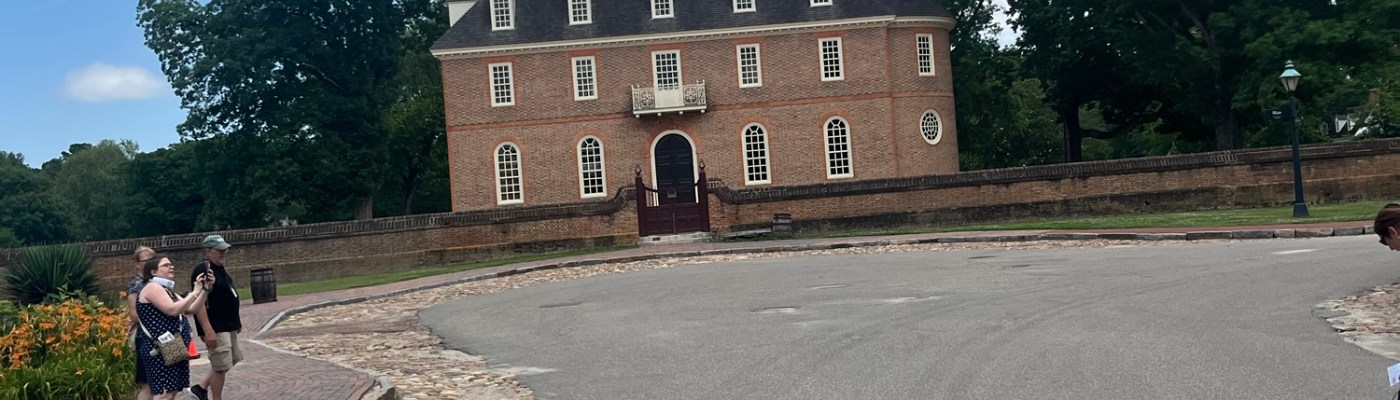
P.S. This post image is also from Colonial Williamsburg VA. I love visiting there!
If you are not 100% sure that you’ll go to Heaven when you die, now is the time to repent and put your trust in Jesus Christ. If you have any questions or doubts about your salvation, click here to learn how you can be saved!
Let me know if you have any comments or suggestions below or you can contact me here! I love hearing from you!
Discover more from Back To Stable Hill
Subscribe to get the latest posts sent to your email.

